Showing posts with label heritage. Show all posts

Friday, 20 October 2017

Personal Histories III

Enchanting Histories

Tracing personal histories is certainly addictive. When you know someone has worked in the same place, sat at the same table, worn away the same steps, and made friendships in the same place as you, learning about these people of the past becomes enchanting.
Today's personal histories blog is about Minnie Cassandra Lovegrove.

Lovegrove Family Tree

Minnie was born in January 1894 to William Roland Lovegrove (b. 1865, Chaddesden, Derby - d. 1903), and Martha Emma Lovegrove, née Wibberly (b. 1871, d. April 1894).
Minnie lost her mother at only 4 months old, and was brought up by her grandparents, William and Emma Lovegrove, and her father William Roland Lovegrove.
William Lovegrove was a Railway Engine Driver in 1881, and his son William R. was a machine apprentice. They lived on Bloomfield Street (off London Road) in Derby. By 1891 William R. is listed as a soldier in the Royal Marine Light Infantry: Chatham Division (enlistment date 11 July 1882). He must have left in late 1891 or early 1892, as he joins the Midland Railway in Derby in May 1892 as a 'Caller-up'. We're not sure what this occupation is - there is some thought that it is another term for 'knocker-up', or perhaps a 'Caller-off/caller-out who "Loads and unloads trucks in a goods  depot; calls out particulars of incoming and outgoing consignments, from  labels on goods, to goods checkers in preparation for their removal  from platform or wagon by goods porters."

Shortly thereafter, in 1893, William R. marries Martha Wibberly, and Minnie is born the following year. Martha dies the same year and Minnie next shows up in the 1901 census.

Borough Isolation Hospital Derby

In the 1901 census, Minnie is listed (age 7) as a patient at the Borough Isolation Hospital. The address of the hospital is Mansfield Road, Derby. It was also known as Derby Borough Infectious Hospital, and the Derwent Hospital. The hospital no longer exists but was in the area now known as Hampshire Road. It was opened as an isolation Hospital in 1883, and closed in 1985-6, when housing was built n the land.
You can see photos of the hospital on Flickr and Picture the Past.

In the 1911 census Minnie and her grandmother are living as lodgers at 39 Grange Street Derby. By this time Minnie has lost her mother, father, and grandfather (who both died in 1903*). Later that year, aged 17, Minnie starts work at W. W. Winter Photographers.

We can see from the wages ledger that she takes over from Nellie Manning:

She clearly has bouts of poor health though as illness is listed under her wages on several occasions.

She eventually leaves in February 1914, although she must spend some time in a sanatorium in 1913 as she is referred to in some of the letters (as Cassie) that Bernard Sheppard wrote to William Henry King.
In a letter dated September 15 1913, Sheppard writes, "Miss Lovegrove is out of the sanatorium again. She came in on Friday evening. She looks a big rosy faced country lass compared with what she was before, and has gained about a stone in weight. Can't say when she will return here yet - got to see the medical advisers first."
Just three days later Sheppard writes in another letter to King, "Cassie had left the premises only half an hour before he came in. She had had a bad coughing bout the night before, and seemed a bit low spirited in consequence. Am afraid that poor kid 'aint going to be patched up to mean anything after all."
Sadly Minnie dies in 1914 aged just 20.

While Minnie doesn't have any offspring she does have a number of relatives via various aunts and uncles, and we are hoping to find a possible living relative through these.
Names we are looking for include: George E. Lovegrove; Harry R. Lovegrove; Velsha M. Lovegrove; Florence, Margaret and Jean Sands; and Doris M. Weston, who would all have been cousins of Minnie. Get in touch if you think you might be related!
Email: office@wwwinter.co.uk
Facebook: @WWWinterLtd


______________________________________________________________
*The Midland Railway ledgers show William R. has several periods of illness from January to May 1897, November 1902 to March 1903, and finally leaving in August 1903.

Friday, 18 August 2017

Personal Histories II

Families, Photos, and Tracing Links to Today

Staff Stories


One of the main early and long serving employees of W. W. Winter was Samuel Wain.
We have highlighted him in some of our social media posts as he was present in a number of staff studio portraits.
Staff group at W. W. Winter, Samuel Wain highlighted.

We were fortune to get a ‘hit’ from these posts as a gentleman got in touch to query whether or not we had identified the correct person. Intriguing!
What we hadn’t noticed was that there were in fact two Samuel Wains in the staff wages ledger - Mr Wain, and S. Wain.
The Mr Wain our gentleman was aware of, was his grandfather who was thought to have worked in a photographers. It turned out this Wain was our S. Wain or, Samuel William Wain, and we could trace him through the census to be the son of Mr Samuel Wain.

Samuel Wain, Framemaker


Mr Samuel Wain (1844-1915) was born to Samuel and Margaret Wain in Littleover, Derby. In the 1861 census, aged 17, Samuel is living with his parents on Devonshire Street in Derby and is already listed as a carver and gilder (i.e. a frame maker).
In the 1871 census we can find no trace of him but we can see his wife (Selina) and child (Samuel William) registered at his parents house in Stockbrook Street. While we can’t account for him, it is likely that he is simply temporarily at another address and his name has been transcribed incorrectly from the original records.
Samuel Wain (back) in the W. W. Winter workshop

Two Generations of Wains


By 1881 Samuel is recorded as living on Burton Road with Selina and son Samuel William who was born in 1869 on the Isle of Wight where his mother, Selina, was originally from. Samuel is listed in 1881 as carver, guilder, and confectioner. Later census data shows Selina as a shopkeeper, so perhaps they owned a sweet shop.
At this point Samuel William is listed as scholar. This changes by the 1891 census where the two generations are working together at W. W. Winter, Samuel as gilder, picture framer, carver; and Samuel William as photographic finisher. They are living at an address on Lower Park which does not appear to exist any more but looks like it was between Wellington Street and Carrington Street.

By 1901 Samuel is working part time at Winters and appears to also be self employed as a confectioner. This coincides with a downturn in the business (by 1911 it would appear that he is a full time gilder and picture framer at Winters, while his wife Selina is a shop keeper). Samuel William has left home by this time, but appears in a ledger of the Railway Employment Records with the details:
Name: Wain, Samuel William
Date of Birth: Jan 5th 1869
Station: Derby
Date / Appointments and Advances / Wages:
April 21 1896 - Employed as Photographic Assistant - £1 1s.
April 28 1899 - Advanced to - £1 4s.
Oct 31 1901 - Left without notice. Competency fair. Conduct good

We can't locate Samuel William or his family on the 1901 census, and it is possible that they travelled abroad, but he reappears in the 1911 census as a 'Warehouseman Core Shop', with his wife, Hannah, listed as a Net Mender. Four of their children are living with them at the time.

Sam Wain


We have been able to fill in a few more details of Samuel William Wain's live via his grandson, Known to his descendants as Sam Wain, Samuel William served in WWI as a stretcher bearer, falsifying his age to join up (he would have been 46 at the start of the war).
He and a companion worked in no man’s land collecting injured troops and brought them back to field hospitals. One day they were overcome by mustard gas and taken prisoner by the Germans. My grandfather’s eyes were damaged by the gas, a German surgeon repaired them, and in due course he was returned to the UK.”

By this time Sam had fathered seven children, the youngest of whom was daughter Ethel. Ethel went on to marry Charles Weston, and it is their son Geoff who has so kindly supplied us with the details about Sam. Winter’s continued to feature in the Wain/Weston family as there are Winter’s portraits of Charles and Ethel taken in the 1930’s most likely by William Henry King.

Geoff tells us: “Unfortunately [Sam’s] eyesight quickly deteriorated [after the war] and he soon went blind in one eye and by 1930 had both his eyes removed. He became a member of St. Dunstan’s (now Blind Veterans UK) and in the late fifties became their oldest surviving member. He died at the grand old age of 96 in 1964.”

Followers of Winter’s heritage will recognise photos of Samuel Wain (above) and we were delighted to bring his great-grandson news of his heritage as well as being able to add to ours. Geoff was unaware of his great-grandfather, and indeed, three generations of Samuels!
Of even greater delight, Geoff has provided us with some images of Sam which we reproduce here with his kind permission. 

Samuel William Wain, carrying grandchild, Geoff, around 1946

Samuel William Wain, 1959

Samuel William Wain, oldest surviving member of St. Dunstans, pictured here in around 1962

Heritage Open Days 2017

Do you think you have a Winters relative? We will be displaying information about staff from around 1900 at our free tours as part of Heritage Open Days. We will be open on 7th, 8th & 9th September with tours at 10am and 12.30pm. Booking is essential due to limited space. Do come along! You can book now by phoning W. W. Winter Ltd on 01332 345224.

Friday, 22 January 2016

A Brief History of....

We are delighted to announce that the Derby Evening Telegraph have agreed to publish 'A Brief History of Winters' highlighting its place in the history and heritage of Derby City.
Below are a few excerpts to whet your appetite!

Midland Road, Derby

"By 1867, a purpose-built studio and premises had been constructed on the opposite side of Midland Road, designed by the Derby architect, Henry Isaac Stevens. The new premises had a row of huge, north-facing and church-like windows, allowing maximum diffused daylight to illuminate the subjects in the studio. [...] A very early central heating system was installed and although the coal-fired boiler has been removed, the huge radiators are still a feature in the building."

Industrial History

"In 1896, William Henry King joined the company as a photographic assistant, operator and re-toucher and was, in effect, Winter’s apprentice, learning all aspects of the business. A very scientific mind enabled William King to work with Winter on pioneering the use of flash photography and, at a later date, to install carbon-arc lighting adapted from the mining engineering company, Davis of Derby and powered by a generator on the premises, which was truly revolutionary for its time."

 Patronized by His Majesty

"Winter’s growing reputation for artistic photography and especially portraiture did not go un-noticed in Derbyshire and there were many famous visitors. The most prestigious patron was King Edward VII, who requested Winter to photograph him and his party at Chatsworth and the magnificent gilt-framed portrait is still on display at Winters."

Winter also photographed Edward's wife Queen Alexandra and the studio became known as 'The Alexandra Rooms'.


Friday, 30 October 2015

James Bond Cameras

Miniature Cameras

Okay, so not actually James Bond's cameras but take a look at the fantastic miniature 'spy' cameras in the Winters / Cameron collection!

V P Twin Camera

The largest of the cameras above is the VP Twin camera, origianlly launched in 1935 and relaunched in 1952. It was manufactured by W. Elliott Ltd in Birmingham, UK; and its body is made of Bakelite. It took 127 film producing sixteen 5/8" x 1¼" exposures. Small enough to fit in a top pocket!
The next size up on the image above, is the Sida Geesellschaft fur photographische Apparate m.b.H., Berlin, Germany. It shot 25x25mm images onto paper-backed 32mm "Sida" rollfilm.

'Super Snaps' Flicker

The Supasnaps Flicker was a 6cm miniature camera dating from the 1980's. Made of injection moulded
polystyrene that took a 110 cartridge film it was suitable for keeping on a keyring and was part of the modern generation of pocket cameras that took over from subminiatures.


Mycro IIIA

We've saved the best 'til last; The Mycro IIIA subminiature was last in the Mycro line and was produced in Japan for export only. You can see just how small it was here against a 50 pence piece. It used 17.5mm paper backed rollfilm with early versions producing 10×14mm exposures and later ones producing a sqiare 14×14mm exposure. The camera came with a leather case, and has a cable release attachment.

We think everyone should have one!


Friday, 25 September 2015

Derby Operatic Company

Derby Heritage

We had another lovely few Heritage Open Days at the beginning of September and were lucky enough again to receive more Winter's original photographs from visitors, one of whom brought in a copy of a Derby Opera Company souvenir programme.

Commercial Photography

Hubert remembers doing regular work for Derby Theatre and Derby Operatic Company, and we were delighted to flick through the pages of the programme for the production of Glamorous Night by Ivor Novello.
You can see from the souvenir programme that the Derby Opera Company was established in 1891, and in the year of the production (1955) was performing at Derby Hippodrome Theatre.
It includes some fantastic portrait photography of the company by Hubert King who rembers cast members coming to the studio on a Sunday morning, ready in their costumes and make up.
I particularly like the portait of Company President, R. P. Williamson, with his fabulous pipe!

The progamme includes a number of adverts and it's good to see a couple of Winter's fellow Derby icons; Foulds, and Bennets.
Winter's still specilaises in portraiture - do come in for a new one or to share your old Winter's photos!

Friday, 15 May 2015

Volunteers Blog - Anne

Untold Stories behind the photographs...

Last week was my final session as a volunteer at Winter's as the first round of funding comes to an end. I've met so many interesting people involved in the project, all with a passion and an enthusiasm for this important process...and that was before I'd even started working on the glass negatives. Something about this project seems to have fired  the imagination of so many. Perhaps it is the uncovering of a whole store of Derby's history or the little frisson of excitement one feels when the next glass negative is cleaned, wondering what will be seen for the first time in 70, 80, 90, or 100 years.

Every photograph raises questions of one kind or another

I have been lucky enough to have worked on three sizes of glass negatives. The large ones were very formal photos and made me wonder; who was  the Grand Master in his full  regalia, or the gentleman photographed at his desk in his own study? Someone who wanted a portrait surrounded by his own books rather than go to the studio–possibly a man of standing?  And who was the lady in a graduation robe? Now the date of that image would be very interesting. 


Some of the middle size plates I dealt with showed shots of the shop floor at Leys and Ewarts, an engineering firm in Derby. Maybe it was for advertising or perhaps for the company magazine. The dress code was collars and ties, even for the man working the massive capstan lathe!


The smaller negatives became more personal; babies, toddlers, wedding photos, passport photographs. Why were the older couple with the unusual name - possibly  Polish - having a passport photograph taken? They look a little wary and uncomfortable in the photo; a button unfastened in the middle of his waistcoat, her coat looking a little too big. Where had they come from and where were they going?

Will mysteries be unraveled

This project is uncovering so many untold stories, some of which may be told, others partly solved and many will lie dormant for many more years until maybe a chance remark will set the story in motion and a family mystery may be unraveled.

Wednesday, 6 May 2015

Volunteers Blog - Daryl


Hello, I'm Daryl one of the Heritage Project volunteers.  Having recently been on the blogging workshop, offered to us by the Winter's Heritage Project, I thought I'd take the plunge and tell you about my experience of my half day conservation sessions at Winters.
I had done my half day of glass negative conservation a few weeks ago, but I was lucky enough to have the opportunity to volunteer for a second half day yesterday.
Being the second time (third if you count the Open Day) that I had been behind the scenes at W W Winter I felt a bit more at home.
I was working again with another volunteer that I had met at the Conservation Workshop in January which helped.  We had also been on the previous cleaning session together and at the blogging workshop.
We were directed to a back room on this occasion to address some 12 inch by 10 inch glass negatives.  Previously I had worked in the newly refurbished room on 3 inch by 4 inch negatives.  On that previous occasion we had not managed to process very many as it was our first visit, but this time we got through quite a few more.

During a break Louisa showed us some images from larger negatives that she had digitised by taking digital photos of them.  Unfortunately many of them were beyond recovery, but not all.  The images often of only part of the original were fascinating.  Although I have to admit to being more interested in the machines and buildings than the people, but that's just me.

There was a great image of what seemed to be a Foden Steam Lorry; our cursory web search suggested that it would have been between 1906 and 1911, over one hundred years ago !  Unfortunately our web search turned up nothing about the company painted on the lorry door "Spa".  The lorry was loaded with what looked to me like wooden crates which could have been beer or pop or could it have been "mineral water".  Was there a market for mineral water 100 years ago ?  I don't know, but I'm sure someone out there will :D
Back at the job we were there to do we cleaned and stored some images of Repton School Hockey Team, several wedding images, a couple of a workshop with belt driven lathes in operation and a company motor coach outing.
It was all over very quickly and since we are almost at the end of the first phase there were no further scheduled conservation sessions available.  I will have to wait and see what the next phase brings.

*Editors Note: We found a few Spa~Water bottles in the glass hole in the cellar. Spa-Tona (formerly Spa-Iron Brew) was a drink produced by Burrows & Sturgess of Derby. Hubert thinks we did commercial photography for them - hence the 'still full' bottles seen in this photo!

Friday, 17 April 2015

Guest Blog 3

I will definitely have to think of a better title for the guest blogs!

Today's guest blog is from is from Melissa and gives a lovely example of the way that photography resonates so much with each of us on a personal level:
I heard about the HLF project on East Midlands Today news and thought, finally something I’d like to volunteer for!

Although I was asked by friends and family, why would I volunteer for something you know nothing about, I’d always say because I want to learn something new. Having recently retired, the opportunity to learn new skills was a gift to me, as well as being able to contribute to a project which has the potential to be such a useful and interesting resource for the public.

After a full day of training it was my turn to start the cleaning and conservation work at Winters.

What struck me most about the whole experience was the second plate I worked on was of a young nurse who had qualified in the 1950’s, having completed her training at Aston Hall Hospital. Probably nothing out of the ordinary for any of the other volunteers, however, I started my nurse training at Aston Hall hospital in the 1980’s and to see this young women at the start of her nursing career had so many echoes in my own life I was blown away!

In that moment I knew I’d done the right thing—to me each photographic plate the volunteers preserve is a “stitch” in the yet unfinished “tapestry” that will be made by all our hard work.


Thursday, 19 March 2015

Support from HLF East Midlands

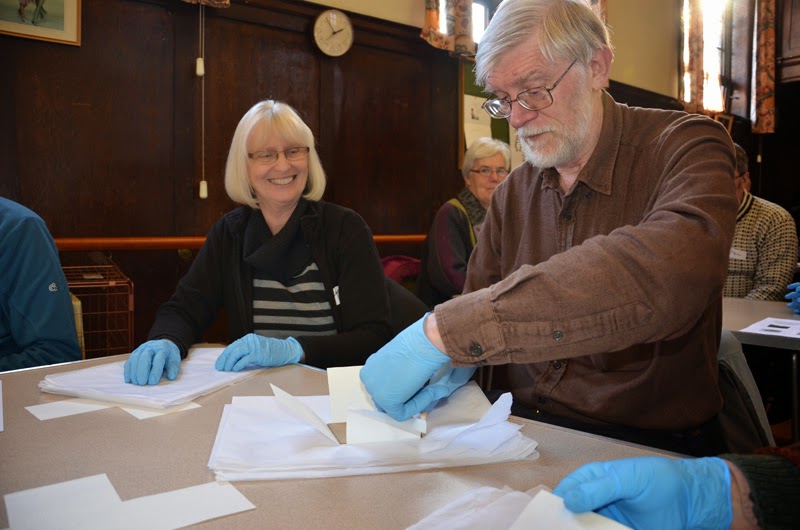
The Heritage Lottery Funded Volunteer Room

Winter's used to have a suite of darkrooms running across the back of the building. With the advent of digital photography and imaging, these wet processing rooms fell out of use. The colour darkroom was set up in Mr Winter's old private office. Being a dark room we didn't see it much but this is what it ended up looking like:
Over a period of four months the layers have been laboriously peeled back, and restored to a workable office space for our HLF project volunteers. The insulation had to be stripped off the walls which revealed the old fire place, sash windows, and a secret doorway!

Once this was done, we were able to rebuild the room back from the bare-brick. Our builder, Jason Toon, worked hard to create the perfect finish:
All this labour that has been going on in the background means that these specially trained volunteers...
 ...can use this room....
 ...to turn these...
...into this!

Follow our blog to keep up-to-date as we scan and publish more images!


Friday, 13 March 2015

Photo Heritage Evidence

FORMAT Festival 2015 is up and running!

There are two ways to access Winter's archive during Derby's international photography festival:

Artist Debbie Cooper has produced a beautiful exhibition using images from large format old glass plate negatives discovered in Winter's cellar.

Inspired by the war time practice of recycling glass from negatives to build green houses, Debbie has re-imagined an architectural space in the form of a hexagonal glass house printed with portaits from Winter's.
The sense of light brings these images to life in a very personal way. Photography allows us to observe the face intensely without fear of social embarrassment, and gives us the space to reflect, 'who is this anonymous person / who am I?', letting our imaginations grow.

Tours* around the Winter's studio allow the public to further investigate the most important part of Derby's heritage; its people.

On display around the studio are many portraits spanning the history of the business over the last 150 years, as well as cameras and lenses. The original daylight retouching studio will be open to view, and take a turn around the large photo studio to see some of the old hand painted backdrops and props.


*Book your tour place via the Quad box office, and browse the FORMAT festival website for all the exiting events and exhibitions over the coming weeks. We look forward to seeing you!

Friday, 23 January 2015

Volunteer Conservation Training

We welcomed forty volunteers to the Church Hall on Horwood Avenue on Tuesday 20 January for an introductory session on conservation.


We were joined by the lovely Anita Hollinshead, freelance museums and conservation expert, who talked us through the considerations involved in heritage collections.


Along with local archivist, Jane Middleton-Smith, we were able to look at the care, cleaning and conservation of historic glass negatives, wrapping them in bespoke acid free envelopes made by Hubert.
The next step is for volunteers to work on site at Winter's putting their new knowledge into practice!
Having been recently to the Derbyshire Records Office, I can tell you how exciting it is to see and handle old documents and we hope that the public will be able to access the images in the future and experience this delight!

Keep up to date with our HLF supported project here and on Facebook at www.facebook.com/FriendsofWinters


Friday, 2 January 2015

Revealing in 2015...

Yikes it is 2015 already!

We are looking forward to the pace picking up in our Photographic Archive Project.
January sees the first 'Collections Care Workshop' for our volunteers. They will be trained up in cleaning, packing and caring for glass negatives, learn about the history of glass negatives and Winters, and get some hands-on experience.

With our enthusiastic volunteer team behind us, we can then start revealing the images in the archive and find out what they might mean for Derby.

It is going to be a gradual process but we excited about tying the community history into the photo archives and sharing them with the county!

Lovely old view up Iron Gate to Derby Cathedral

Friday, 7 November 2014

Unearthing History

Archiving Project

Time for a quick catch up on our Heritage Lottery Funded archiving project. We have had wonderful support and volunteers are champing at the bit to get started. However, in trying to make a viable space for people to work we have run into a bit of a road block....
The cellar underneath the new archiving room-to-be.

As you can see there is a huge pile of rubble still to shift, but we need to clear it in order to insulate the room above. This section was completely full - the doorway was completely blocked. As clearing has commenced we have found many artifacts, including complete glass negatives, old bottles and packaging. It look like it was used as the on site dump and we are being careful to sift through as we go.

Anyway, now that we know what we are up against we are creating a temporary space for volunteers to work in the office so we can get on with the actual archiving. Opening the workroom proper will have a to wait a little while but will definitely be a cause for balloons and a few bubbles when we achieve it!

Some of the waste glass that has been shifted below the new work room. It stands around a metre deep.


Glass plate negatives, old chemical bottles, and packaging are being salvaged.

The negatives we really want to start working on

Thursday, 5 June 2014

A Rather Fabulous Foursome


Who are these handsome lads and lasses? Who indeed!

We may not know who they are or what they did but they have one thing in common for certain - they were all photographed at W. W. Winter Photographer's in Derby, on quarter plate glass negatives, most likely in the late 1940's.

How do we know?

There's a rather fabulous project going on at W. W. Winter's at the moment. We have our very own Artist in Residence. Debbie Adele Cooper has been combing our archive, delicately scanning these old glass negatives to reveal a myriad wonderful faces. Her research has taken her back through traditional darkroom printing and now onto vintage photography techniques.

Get involved and have your photo taken!

The rediscovery of these lost faces reminds us of our personal histories and the traces we leave... perhaps the above sitters had families in Derby. Maybe their offspring are living here today. Do you look like one of the people in the portraits that Debbie has revealed? Then she wants to hear from you now!
You don't have to be related to the people in the pictures, just have a resemblance to the original, and a link to Derby yourself.

Take a look at the DerbyAnon website - new images are still being added.

Follow the project on Twitter and Instagram via @archive_artist

Contact Debbie via email through info@debbiecooper.org

We look forward to seeing you in the studio and finding out whose face you fit!

Friday, 16 May 2014

Excitables!

What could be more excitable than discovering something new?

Uncovering something old!
The Heritage Lottery Fund Bid went in on 8 May and there is an eight week or less countdown to the result. This has given us itchy feet and we keep tinkering here and there with the old secretary's room at the back of the office, which we hope to transform into a work space for digital archiving.
Well, a little poke and here and a little tap there has uncovered A SECRET DOOR!!
Firstly - we have checked and it doesn't go to Narnia, but needless to say it is to us part of the wonderland that is Winter's.
It's relatively small - 6 feet in height, standard width (as you can see in the photo, half the door is still in hiding) has glass panels and is painted in a light green. It has been covered up until this week by insulation board; we wouldn't have know it was there but for some rummaging and tidying.
It would have led from the secretary's office to the storeroom where the safe was kept. Personally I can't wait until its is completely uncovered just to find out if it makes a really good creaking sound.


And of course, whoever blocked the door off had the marvelous forethought to stuff the gaps around it with newspaper: The Daily Express, Saturday April 18 1970. I'm looking forward to reading the cartoons!

Can't wait to tell you what we find next :-)