Friday, 16 May 2014

Excitables!

What could be more excitable than discovering something new?

Uncovering something old!
The Heritage Lottery Fund Bid went in on 8 May and there is an eight week or less countdown to the result. This has given us itchy feet and we keep tinkering here and there with the old secretary's room at the back of the office, which we hope to transform into a work space for digital archiving.
Well, a little poke and here and a little tap there has uncovered A SECRET DOOR!!
Firstly - we have checked and it doesn't go to Narnia, but needless to say it is to us part of the wonderland that is Winter's.
It's relatively small - 6 feet in height, standard width (as you can see in the photo, half the door is still in hiding) has glass panels and is painted in a light green. It has been covered up until this week by insulation board; we wouldn't have know it was there but for some rummaging and tidying.
It would have led from the secretary's office to the storeroom where the safe was kept. Personally I can't wait until its is completely uncovered just to find out if it makes a really good creaking sound.


And of course, whoever blocked the door off had the marvelous forethought to stuff the gaps around it with newspaper: The Daily Express, Saturday April 18 1970. I'm looking forward to reading the cartoons!

Can't wait to tell you what we find next :-)

Friday, 2 May 2014

Straight from the horses mouth!

Reproduced below is part of the introduction from The Winter's Collection of Derby, volume II, published in 1996.
I'll be talking to Hubert of the next few weeks to get a update - note the absence of any mention of digital photography twenty years ago!

My Winter's Apprenticeship
by H.W.King
(written in 1995)


My family's association with W.W.Winter Ltd began in 1896 when my grandfather joined the company as a photographic assistant, becoming the sole proprietor by the time I was born. Some of my earliest memories are about Winters, for the company played such an important role in all my family's life and it seemed inevitable that I would develop a keen interest in photography. I found both my grandfather and uncle, Austin, very informative and I learnt lot about photography, printing and so on, even before my formal training began.
When I left school at the age of 14, I joined the company as an apprentice. My first responsibility was washing prints to remove all trace of the chemicals. This was done with bare hands in cold, running water, which during wintertime became ice-cold, something which I remember with painful memories!
My early years at Winters coincided with a successful time for Derby County Football Club. The company had been the official photographers for many years and when the Rams won the FA Cup in 1946, we were asked to go to the Baseball Ground to take some photographs of the team with the trophy. I was asked to carry the coveted FA Cup on to the pitch ready to be photographed — and as a Derby County supporter, I found this a tremendous honour.

Having mastered the art of daylight printing, I was relieved to be moved inside to the comparative warmth of the retouching room, to be taught the skill of retouching. By today's standards, glass negatives were very basic at that time and presented many limitations when printed. Using special graphite pencils, negatives had to be retouched to some degree to
enhance the subsequent print. At the same time, it was possible to remove any unwanted wrinkles and skin blemishes, thus making the subjects appear more youthful, possessing what could be virtually flawless skin.
When I was 18, I started a course at the Nottingham College of Arts and Crafts. Having learnt many of the basics in a practical setting, the course gave me the opportunity to learn more theory and to gain an understanding of more advanced photographic applications. And it was only towards the end of the course that I was finally allowed to do some studio photography.
Photography has changed so much since I took my first photograph. The equipment was so heavy and bulky, there was no electronic flash and negatives were made of glass. By today's standards, the basic nature of the technology presented many limitations. It is so much more controllable today. The time it would take just to take one photograph meant that it was all too easy to 'miss the moment', especially when photographing animals and children. Half-plate size glass plates (61/2ins x 43/4ins) would be already loaded in the slides. The camera would then have to be focused. A magnifier would be placed on to the ground glass screen which was then moved backwards and forwards to find the point of sharp focus. A slide would then be loaded into the camera back. After as much as one full second exposure time, the exposed slide would be removed, the camera refocused and another unexposed slide put in its place. All this had to happen before the photographer could even begin to think about catching the required expression. During a portrait session today, several frames on a roll of film can be exposed in a matter of seconds, something which is now considered essential, especially when photographing animals and children.

Time was also the critical element in doing photography on location, particularly at weddings. Using the 5in x 4in press camera, I was soon covering weddings. This camera was small enough to be hand held and was much more flexible than the larger, more bulky studio cameras. However, though the negatives were smaller, the slides still had to be changed manually after each exposure. Because of the length of time involved in preparing the camera, and because the glass negatives were still relatively bulky, the wedding coverage was generally limited to about 24 shots, as opposed to today's 60 or more. The sheer logistics of taking on site heavy glass negatives made a more extensive wedding coverage very difficult.
W.W.Winter Ltd has proved to be an ideal place to learn about photography. This was true for myself as well as for the people who have worked for the company since. Being general practitioners in the field of photography, it was possible to learn about every aspect of the trade, adopting the new technology when it arrived without forgetting the more traditional skills. However, the one thing which I learnt when I first started - and something which the company still values today - is the importance of good service.

Friday, 11 April 2014

Heritage Lottery Funding Bid


Progress

Hours of discussion, paperwork, statements of interest, meetings etc are starting to come together for Winters. We had a hunch there would be some interest based on the amazing support we got from the public during last years Heritage Open Days. There are of course no guarantees but we are hearing the right noises going in to this final stage of application.

When will we know?

Our full complete application is submitted in two weeks and we should have an answer by July. Our thoughts? We can't help but dream big!

Over the side entrance - three 'Ws' and 1867

The dream!

We will need your help to turn the dreams in to reality. We hope to dip our toe in the water with an archiving work room and bring those plate negatives back to life but this is just the beginning. It is developing 'Friends of Winters' that will be the foundation of things to come. We need a body of people who want to be active in restoring, conserving and developing every aspect of our heritage with emphasis on the building (which already has a grade 2 listing) and access to the public.

The ceiling cornicing on the left is currently hidden by a lower false ceiling. Wouldn't it be lovely to have all these architectural details revealed?

Outcomes...

Will it be a museum? A center for study? A center for learning? Is it important to 'travel back in time' and realise a museum studio; to catalogue all the images onsite; to transfer skills and knowledge of traditional photography? We believe that all these things are important, but you will have to drive the project (with our full support) whilst we concentrate on the day-to-day running of the business and our lovely 21st century customers.
We are hugely grateful to our current list of volunteers offering their help. Do get in touch if you are also interested in cataloguing and archiving. However, also let us know if you would like something to really get your teeth into. Do you have a passion for heritage and / or photography? May be you have some project management experience, or have worked on similar projects in the past? We want to hear from you please!

 How many feet have trodden these stairs. Look at the curve in the lead where 150 years of wear is showing.


Get in touch

Email us on office@wwwinter.co.uk to let us know. There is no commitment at this stage. We are simply putting together a pool of interested parties. who will love and cherish this place as we do :-)

Friday, 4 April 2014

Winter's in Artsbeat Magazine

We were visited last month by the rather brilliant Amanda Penman of Artsbeat Magazine who has written a lovely article on the business and the 'behind-the-scenes' of the history of the company often invisible behind the running of a modern portrait photography studio.
We have already had feedback from the feature with offers of help for the project-in-waiting that is our photo archive. Our Heritage Lottery Funding bid is now being processed (fingers crossed) and if successful we will be able to move into phase one. This will involve renovation of the old colour dark room and kitting it out as a workroom for archiving. At this point we will need you! We are really grateful for the offers so far but do keep them coming in; whether it's a casual interest in photography and / or history or you have previous experience of a similar project we promise to keep you in tea and coffee!


Owner and MD, Hubert Weston King, wanted to say a big thanks to both Amanda, and to Nick Lockett for photographing here for the magazine.
Behind Hubert you can see a small indication of the archives held here. Each box is filled with negatives, some portraits, some from industrial work. Times this by many times over and you start to see the nature of the task ahead of us.


Contact us by email on office@wwwinter.co.uk if you would like to get involved, and follow our Friends of Winters Facebook page for regular updates and snippets of the goodies we come across.


Louisa and Angela upstairs in the old daylight retouching room with examples of Victorian portraiture. It is this part of the archives that we would like to make more accessible to the public via a small museum.


Friday, 28 March 2014

Quarter Plate Studio Portraits

Butter Wouldn't Melt!

Take a look at these two cherubs.
I picked them up off the top a box in the cellar today. One of so many captured here in the studio over the years. It's difficult to date these but I'm hazarding a guess at 1940's to 1950's based on clothes and hairstyles. Later than this, and we would be moving into colour.
You can make out the word 'Peach' at the bottom of the image (most likely the familly name) along with other reference details. These were written directly onto the plate and relate to an entry somewhere in the ledger books.
The black blob (for want of a better word) on the left is where the emulsion has peeled away but it is a testament to traditional photography methods that the image remains almost wholly intact: how are you old CD's holding up?

The Lightest Touch

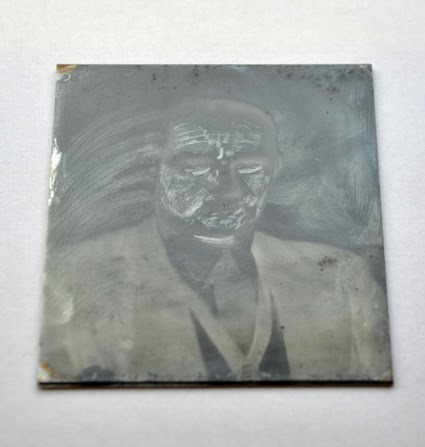
Another one from the pile - this image has got me hooked.
Never mind airbrushing or Photoshop - look at the softness of the skin.
The light is gentle but exacting - the modelling highlights his features, his expression is serious but relaxed. What I find really exciting about this one though is the hand retouching directly on to the plate. Retouching was predominantly done by women (perhaps the extra colour receptors in our eyes make us more adept with detail?) Imagine the women working in a row in the daylight retouching rooms at the top of the building bent over these small portraits.
These images I am sharing are all on quarter plate glass negatives. A 'whole' plate is 8in x 6in so these are 4in x 3in, about the size of a polaroid. At this small size the retoucher had to work their magic knowing it would be enlarged when printed, magnifying their handiwork.
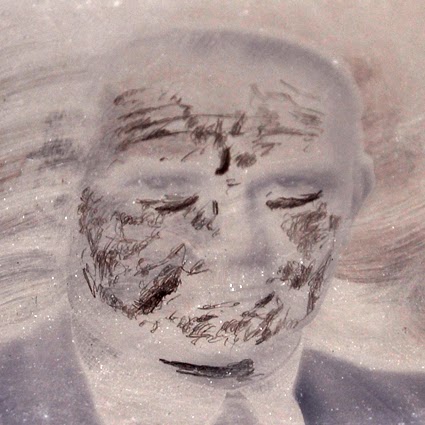
And what was this handiwork like? If you flip the plate over and tilt it to the light you can see!
The swirls around the head are brush marks in the emulsion, the details that interest me are the marks on the face. With a bit of photoshop magic you can get a better idea of what is going on...


These pencil marks provide two services: the lighten areas, and they smooth out lines. Dark circles under your eyes? No problem! Deep set frown lines? Not any more! The head in the right hand side image is about to scale so you can see the accuracy needed.
And that's how you make a classic soft portrait without softening the focus - no need for a stocking over the lens :-)


Friday, 7 March 2014

Ghostly goings on...

Capturing your spirit?
It is of course a photographer's job to capture people forever. It enables us to hold onto happy memories when loved ones are no longer around. But maybe photographs really do capture a bit of your soul?
Being in such a well used old building it's impossible to feel the presence of all those who have walk up the stairs to the studio over the last 147 years.

Winter House does in fact have a very homely feel, a testament to being in the King family for so long, but there is the odd trace that we might not be alone. A few customers have seen a well dressed Victorian lady descending the staircase but the current team regularly experience the strong and unmistakeable smell of woodbines.

To old friends...
We like to think it is old Charlie - Charles Henry Barson, with woodbine in hand. Charlie worked at Winters as  photographer and print er from 1928 until his retirement in 1981. However, he remained a part of the team spending a day a week sorting through old negatives, using his knowledge and experience to identify people, places and dates.
In typical work mate banter he assured his colleagues that if there was an afterlife he would let them know. On returning to the office from his funeral in 1989, staff mused on where Charlie was now, and to the second an almighty bang came from the old postage scales as if a great weight had been dropped on them. There was no explanation for the noise so we like to think it was Charlie saying goodbye :-)


Friday, 3 January 2014

Oldest Photography Studio?

Just exactly how old?

There has been much debate here about whether we can claim to be the oldest continuously operating photography studio in the UK, if not the world. We can say with absolute certainty that the studio that we operate from today opened in 1867 - pretty close but not the oldest. However, the business itself is another matter.

The other side of the Midland Road

Emmanuel Nicolas Charles had a photo studio on the other side of Midland Road from 1856, which he ran until his death in 1863, at the young age of 36. During this time he had taken on an assistant, Walter William Winter.


On Charles' death, the business passed into the hands of his widow, Sarah Charles (nee Ball)* and her three young children. By Spring of 1864, Winter had married Sarah and taken over the business. It should be noted that at the time Sarah would have been 33, and Winter just 22.

The Alexandra Rooms

From 1864 Walter William Winter was advertising the business as W. W. Winter, late E. N. Charles, still operating from 2 Midland Road. However, by 1867 Winter had seen his purpose built photo studios, designed by architect Henry Isaac Stevens, open for business.

Victorian women in business?

 *If you have any information about Sarah Charles, do get in touch. We are particularly interested to know whether Sarah ran the business for the period between the death of her first husband and her marriage to Winter.